David Suárez Estrada arrives in the kitchen before dawn. The first rays of sun barely light the Poblado skyline when the chef is already reviewing every ingredient that arrived that morning: fresh fish from the Pacific, herbs from eastern Antioquia, olive oil from the Mediterranean, tropical fruits from different regions of Colombia. Each one has a name. Each one has an origin. That review isn’t protocol. For Suárez, the creative process starts at the market, with the producer, with what arrived that morning — not in the kitchen.
Technique at the service of the ingredient
There’s a principle that defines his cooking: technique at the service of the ingredient, never the other way around. In many high-end kitchens the ingredient is the vehicle for showcasing what the chef knows — the perfect sous vide, the precise spherification. At La Makha, the technique is there because the chontaduro needs that exact point to give what it has, because the octopus from La Guajira arrives better on the plate when the cook knows when not to touch it.
His inspiration doesn’t come from avant-garde cookbooks. It comes from markets, from producers, from the ingredient that arrives that day at an exact point of ripeness. A chontaduro at its moment. A criolla potato of intense yellow. A chili from a specific hamlet in the Amazon. The dish is designed around that starting point, seeking to exalt its essential flavor, not hide it.
“We want every diner to feel the Mediterranean in every texture, but for the soul to remain Colombian.”
— David Suárez Estrada, executive chef of La Makha
That duality — Mediterranean technique, Colombian soul — took years to find its form. Vacuum cooking, foams, controlled fermentations, dehydrations are tools Suárez brought from one tradition and put in service of another. Not to impress with them, but because with those specific tools the Colombian ingredient gives more than it would any other way.
Responsible cooking
David works directly with local producers, supporting rural communities and reducing the supply chain. As he puts it himself: “Cooking with purpose is cooking with a future.”
Affective memory
Many dishes are a dialogue between memories and avant-garde training. A childhood yuca purée, passed through a fine sieve and accompanied by a chicharrón powder that amplifies its flavor.
Art and science
Every recipe goes through a process of research and testing. Modern techniques — vacuum cooking, foams, fermentations — combined with ancestral methods that recover culinary memory.
Precision and choreography
La Makha’s kitchen is a laboratory where every movement has intention. The team works in sync, following the rhythm the chef sets in each service.
A day in La Makha’s kitchen
La Makha’s kitchen is a laboratory, but not in the sense restaurants use that word to talk about molecular technique. It’s a laboratory because every day something gets adjusted: the cooking point, the pairing, the temperature. The evening service is the result of a process that starts many hours earlier.
Before dawn
Visita a los mercados. David selecciona personalmente los ingredientes del día junto a los productores que conoce por nombre. El menú del día empieza a tomar forma aquí, no en la cocina.
Morning
Llegada al restaurante. Revisión de cada ingrediente: pescados frescos del Pacífico, hierbas del Oriente antioqueño, frutas tropicales. Cada uno tiene origen verificable. Los cuchillos empiezan a moverse con precisión quirúrgica.
Afternoon
Ensayo y ajuste. Cada receta pasa por un proceso de investigación. El punto exacto de cocción, la textura de una salsa, la temperatura de un maridaje. Nada queda al azar antes del servicio.
Evening
El servicio. Una coreografía donde David supervisa cada detalle y, con frecuencia, sale de la cocina a explicar los platos en la mesa. Varios comensales lo describen como el momento más memorable de la noche.
Colombia as a research territory
David Suárez’s relationship with Colombia goes beyond buying local ingredients. He and his team make regular trips to different regions to learn directly from communities: traditional cooks from the Pacific, native potato farmers in Nariño, herb gatherers in the Amazon.
That firsthand knowledge becomes a fundamental part of his recipes. On the Pacific coast he observed how local communities cooked fish wrapped in bijao leaves over embers, accompanied by native vegetables and wild herbs. In the Amazon, he works with communities that harvest açaí, copoazú and camu camu in wild, sustainable ways. In the Caribbean and in Afro-Colombian communities of the Pacific, he found the viche canao — that artisanal distillation that today appears in La Makha’s flan.
Each of those trips ends up on the menu. With the name of the region, with a story behind it, with a producer who receives a fair price for an ingredient that most luxury restaurants wouldn’t know by name.
The identity of a cuisine of one’s own
Reading La Makha’s menu and tracing its ingredients, four decisions emerge that Suárez makes systematically and that set him apart from other author restaurants in the city.
- First: Colombian ingredients aren’t on the menu for exoticism or trend, but because they’re the best technical option for that specific dish. The chontaduro isn’t in the ceviche’s tiger’s milk to surprise — it’s there because its nutritional profile and flavor allow textures and nuances impossible to achieve with lime alone.
- Second: research is active and continuous. There’s no fixed recipe that hasn’t gone through a process of testing, field trip and revision. The menu reflects what the chef learned last week, not what he decided six months ago.
- Third: innovation happens within tradition, not against it. Modern techniques — fermentation, cryogenics, sous vide — are translation tools: they serve to tell in a contemporary language stories that have lived for centuries in Colombian ingredients.
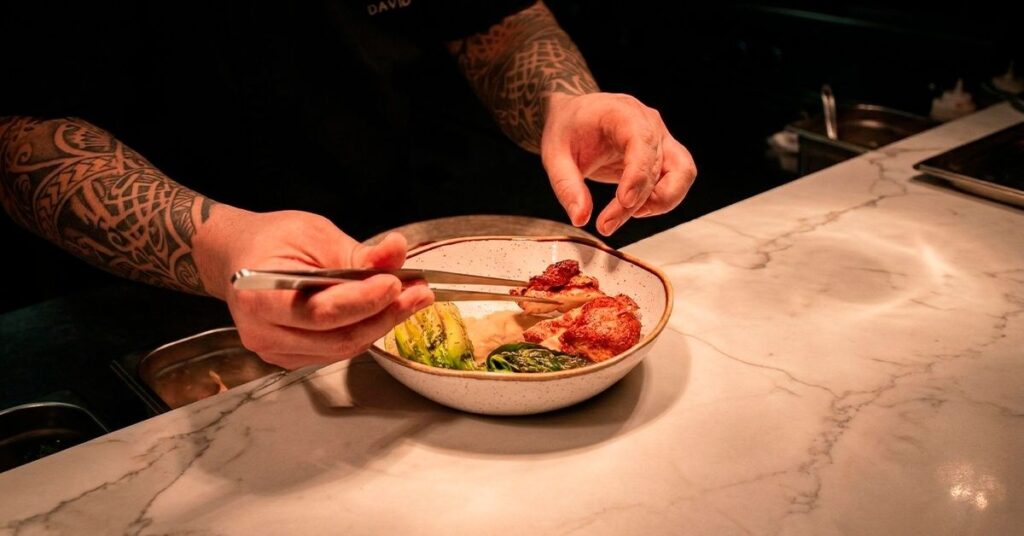
- Fourth: the team. At La Makha the service is a choreography where Suárez oversees every detail — the wine temperature, the sauce texture, the exact cooking point. There’s no improvisation on the plate. What seems natural took many rehearsals.
His legacy in Colombian gastronomy
David Suárez Estrada‘s work has an effect that goes beyond the restaurant. He has shown that Colombian haute cuisine doesn’t need imported ingredients to be sophisticated, and that gourmet doesn’t mean foreign. That’s no small thing in a market that for decades looked outward by default.
By paying fair prices for exceptional ingredients, he has given a real economic incentive to farmers to preserve native varieties that industrialization had pushed out of the market. By putting curuba de indio, cubio, and criollo corn from the Montes de María on the menu, he has rescued ingredients that lacked demand in author gastronomy.
And by coming out of the kitchen to explain each dish at the table — that gesture his diners don’t forget — he turns dinner into something different from what one expects at a hotel restaurant. Several describe it with words like “wonderful” or “never experienced before.” That doesn’t happen by accident. It happens because Suárez understands that the dish doesn’t end when it leaves the kitchen.
Frequently asked questions about chef David Suárez Estrada
Who is the chef at La Makha in Medellín?
David Suárez Estrada is the executive chef of La Makha, the restaurant at Binnhotel in El Poblado, Medellín. He is the creator of the origin cuisine concept that defines the restaurant’s gastronomic offering.
What is David Suárez Estrada’s cooking philosophy?
His central principle is “technique at the service of the ingredient, never the other way around.” He works with Colombian ingredients of verifiable origin and applies Mediterranean and avant-garde techniques to intensify — not hide — the product’s flavor.
Does David Suárez Estrada come out to the tables during service?
Yes. When in service, the chef comes out of the kitchen to explain the dishes at the table. Several diners mention it in their Google reviews as the most memorable moment of the La Makha experience.
What producers does the La Makha chef work with?
David Suárez works directly with small-scale local producers in Antioquia, Cundinamarca, Boyacá and other regions. He also collaborates with indigenous and Afro-Colombian communities from the Pacific and the Amazon to obtain ingredients with full traceability.
How do I make a reservation at chef David Suárez Estrada’s restaurant?
Reservations are made through Binn Hotel official channels. The restaurant serves both hotel guests and outside visitors.
The best way to understand David Suárez’s vision is to sit at his table.
Discover the restaurant on La Makha’s page at Binnhotel. Instagram: @lamakharestaurante.