Controlled fermentation, confiting, foams, dehydration—at La Makha, every technique has a reason for being.
Some restaurants make technique the main argument of the menu. Spherification appears because it’s spectacular. Smoke because it surprises. Technique as the protagonist, the ingredient as an excuse. At La Makha the order is reversed.
Chef David Suárez Estrada spent years in European kitchens mastering the technical vocabulary of fine dining — sous vide, foams, fermentations, dehydrations, clarifications. When he returned to Colombia and built La Makha, he used that vocabulary for one specific purpose: to make chontaduro taste more like chontaduro, to bring octopus from La Guajira to the plate with the texture it would have if it had just come out of the water, to make a coconut flan with viche canao say something it couldn’t say cooked any other way. Technique in service of the ingredient — never the other way around.
The principle: technique serves the ingredient
The chef puts it plainly: “Technique in service of the ingredient, never the reverse.” That has concrete consequences for how decisions get made about which technique to apply to each dish. The question isn’t “what technique can I show here?” — it’s “what does this specific ingredient need to give its best?”
An octopus from La Guajira slow-cooked at low temperature keeps the elastic texture of the live mollusk. Cooked over high heat, it would tighten. The technique isn’t there to impress — it’s there because it’s the only way to reach the exact point. Dehydrated hibiscus powder from the Montes de María concentrates the burgundy color and floral acidity of the fresh flower in a fraction of the volume. Without that technique, wet hibiscus would visually overwhelm the black rice it appears on.
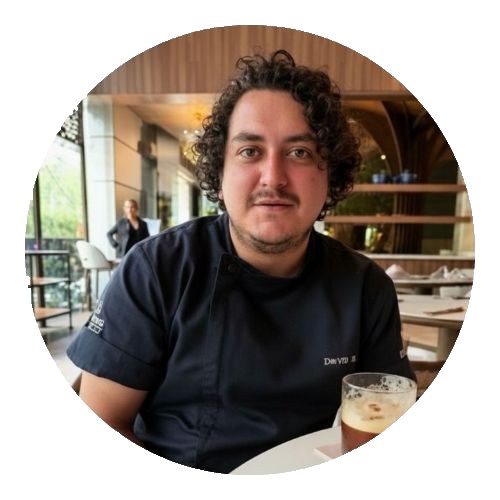
“David Suárez Estrada combines modern techniques — sous vide, foams, fermentations — with ancestral methods that recover culinary memory.” — Binn Hotel · Chef in action
La Makha’s techniques and what they’re for
Sous vide — French technique · High precision. The ingredient is sealed in a vacuum bag and cooked in water at an exact, constant temperature — typically between 50°C and 85°C for extended periods. Uniform temperature produces a result no conventional method can replicate: no heat gradients, no moisture loss, no risk of over or undercooking.
At La Makha: the three-stage pork belly uses sous vide as one phase to soften the fat fibers before the final sear. The octopus from La Guajira goes through controlled temperature so the texture is elastic but never rubbery. Sous vide is why the meat arrives at the table at its exact point.
Confit — French technique · Preservation and texture Slow cooking of the ingredient submerged in fat — oil, butter or animal fat — at a low, constant temperature. Immersion in fat protects the ingredient from direct heat contact, producing soft textures and a flavor concentration that cooking in water or dry heat can’t achieve.
At La Makha: the confit octopus from La Guajira is one of the most frequently mentioned dishes in guest reviews. Confit lets the mollusk keep its marine flavor while developing a silky exterior texture. Mediterranean olive oil acts as the cooking medium for an ingredient from the Colombian Caribbean.
Dehydration — Preservation technique · Flavor concentration. Controlled removal of water from an ingredient through low temperature and airflow. The result concentrates flavor, changes texture and reduces volume. It can turn a liquid into powder, a fruit into a chip or a fresh herb into an intense condiment.
At La Makha: the hibiscus powder from the Montes de María that appears in the Arroz Meloso is dehydrated and pulverized hibiscus. It concentrates the burgundy color and floral acidity in a minimal amount. The smoke powder that accompanies the oyster mushrooms uses the same technique on smoked wood. Dehydrated potato and cassava skins become chips or sauce thickeners.
Controlled fermentation — Ancestral and modern technique · Flavor development. A microbiological process in which bacteria, yeasts or fungi transform the sugars and proteins of an ingredient into acids, alcohols and flavor compounds. In fine dining it’s used to develop umami, acidity and complexity in short, controlled timeframes.
At La Makha: kimchis with Andean vegetables, vinegars from ripe Colombian fruits, local fava bean miso. Fermentation isn’t just preservation — it’s flavor that doesn’t exist in the fresh ingredient. Fermented broccoli stems and carrot tops become pickles with a depth that fresh vegetables simply don’t have.
Foams and emulsions — Avant-garde cooking · Texture and presentation. Air incorporated into a liquid to create light textures that carry intense flavor with minimal volume. Foams allow a strong flavor — goat yogurt, Paipa cheese, coconut sauce — to be presented in a way that doesn’t overwhelm the other elements on the plate.
At La Makha: the goat yogurt and Paipa cheese foam that crowns the lamb cappelletti is the most visible example. Paipa has a potent flavor — as a foam, that flavor arrives with the texture of a cloud. The Pacific coconut foam on the Arroz Meloso carries the creaminess of coconut without the black rice losing its independent texture.
Clarification — Bar and fine dining · Visual and flavor purity. A filtering process that removes particles from a liquid — stock, juice, distillate — leaving visual transparency without losing flavor. A clarified bone broth looks like water and tastes like an intense reduction.
At La Makha: the Esfumado cocktail uses clarification to achieve a transparent drink with flavors of aged rum, tamarind and orange. In the kitchen, clarified fish-bone stocks produce visually clean sauces with intense marine depth. Clarification resolves the contradiction between strong flavor and clean presentation.
Pickling and marinating — Ancestral technique · Acidity and texture. Immersion of an ingredient in an acidic medium — vinegar, citrus, brine — to modify its texture, develop acidity and preserve. In fine dining the time and concentration of the acid medium are controlled to reach specific texture points.
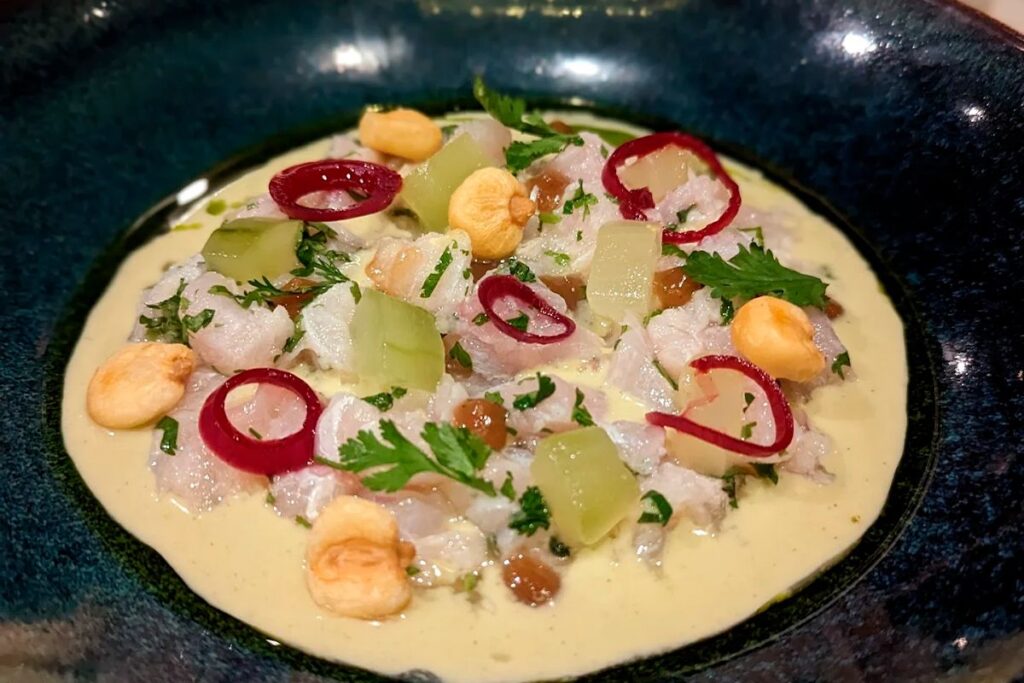
At La Makha: the pickled watermelon in the ceviche has a firmness that fresh watermelon doesn’t — pickling densifies it. The house red wine-pickled beets in the pork belly have acidity calibrated to contrast with the pork fat without overwhelming the huacatay. Pickled güatila in the oyster mushroom dish works the same way: acidity as a counterweight to the yogurt.
Ingredient powders — Contemporary fine dining · Concentration Transformation of a solid or dried ingredient into fine powder through dehydration and grinding. Powder concentrates flavor and allows it to be applied in minimal amounts with precise visual and gustatory distribution.
At La Makha: spring onion powder in the Corn Cracker, San Marzano tomato powder in the lamb, smoke powder in the oyster mushrooms. Each one contributes flavor in exactly the right amount — something a caramelized onion or whole tomato wouldn’t allow.
Colombian ancestral techniques
La Makha no trabaja solo con técnicas de vanguardia europea. Una parte igual de importante de su repertorio técnico viene de las tradiciones culinarias de los territorios colombianos que proveen los ingredientes.
Ancestral techniques
- Bijao leaf cooking: a pre-Hispanic Pacific method that cooks fish in bijao leaves over embers. The leaf protects, adds aroma and retains moisture.
- Encocado: a coastal technique of stewing in coconut milk. At La Makha it’s used as a pasta base sauce — a Caribbean technique in an Italian format.
- Traditional fermentation: the viche canao from the Pacific is the result of an artisanal distillation that hasn’t changed in generations. It appears in the closing flan.
- Colombian sourdough: breads made with slow fermentation of local flours. The herb bread in the stracciatella dish follows this process.
Avant-garde techniques
- Sous vide: vacuum cooking at exact temperature. Confit octopus, three-stage pork belly.
- Cryogenics: use of liquid nitrogen to preserve ephemeral textures and aromas — instant creole cilantro powder, frozen textures in desserts.
- Technical clarification: filtering of stocks and distillates for visual transparency without flavor loss.
- Spherification: encapsulation of liquids in gel membranes. Allows a liquid flavor to burst in the mouth in solid form.
How the techniques apply across the menu
| Dish | Main technique | What it does in this dish |
|---|---|---|
| Octopus from La Guajira | Confit + Sous vide | Elastic, silky texture. Without these techniques the octopus would be rubbery or dry. |
| Corn Cracker | Spring onion powder + Pickled sorrel | The powder adds flavor without moisture that would soften the arepa. The pickled sorrel gives calibrated acidity. |
| Oyster mushrooms | Yogurt foam + Smoke powder + Pickled güatila | Three different techniques in a single vegetarian dish to build flavor depth without animal protein. |
| Ceviche | Pickled watermelon | Pickled watermelon has a firmness fresh watermelon lacks. It holds up against the leche de tigre without falling apart. |
| Pork belly | Three stages (Sous vide + sear + glaze) | Each stage transforms a layer of the pork. The result: crispy outside, silky inside, no raw fat. |
| Lamb | Paipa cheese foam + San Marzano tomato powder | Paipa in foam delivers its intense flavor without the physical weight of solid cheese. The powder adds visual and gustatory acidity. |
| Arroz Meloso | Dehydration (hibiscus powder) + Coconut foam | Hibiscus powder gives deep color and floral acidity without adding liquid. The foam carries coconut flavor without altering the rice’s texture. |
| Flan (dessert) | Artisanal distillation (viche canao) | The alcohol cuts through the sweetness of the coconut and bitter orange anchors the acidity. |
The European training behind the technical mastery
David Suárez Estrada’s technical command comes from his formative years in European kitchens. In Spain and France, in Michelin-starred restaurants, he learned the discipline of mise en place — that system of precise preparation that precedes every service — and the handling of precision techniques that have been developing in Europe for decades.
What he brought back wasn’t the European menu. It was the method: the way of thinking about cooking as a system of perfectly orchestrated processes, textures and flavors. Applying that method to Colombian ingredients — to chontaduro, to octopus from La Guajira, to viche canao — produced something no European kitchen could have created, because those ingredients don’t exist in Europe.
The question he asked himself on returning is the one that defines La Makha: how would the great European masters apply their techniques if they had Colombia’s biodiversity at their disposal? The answer is in the tasting menu at La Makha.
Frequently asked questions about fine dining techniques at La Makha
What fine dining techniques does La Makha use?
Sous vide, confit, dehydration, controlled fermentation, foams, emulsions, clarifications, pickling and ingredient powders. Each technique is chosen because it solves a specific problem for the Colombian ingredient it works with — not for spectacle.
Does La Makha use molecular cooking techniques?
Yes, but with a specific criterion: the technique serves the ingredient, not the other way around. Spherification, clarification and cryogenics appear when they solve something no other technique can — not to impress visually.
Does La Makha combine modern techniques with traditional Colombian ones?
Yes. Pacific encocado, bijao leaf cooking, artisanal viche canao distillation and Colombian sourdough coexist on the menu with sous vide, clarifications and precision-controlled fermentations. Both traditions share the same purpose: to intensify what the ingredient already has.
Where did La Makha’s chef learn fine dining techniques?
David Suárez Estrada trained in Michelin-starred kitchens in Spain and France, where he mastered the technical vocabulary of European avant-garde cooking. He then applied that learning to Colombian ingredients when building La Makha’s culinary proposal.
Can guests see the techniques in action at La Makha?
Yes. La Makha has an open kitchen concept that lets guests observe part of the process. Chef David Suárez Estrada also typically comes out to explain dishes at the table, including the techniques behind each preparation.
Experience the technique in person. The menu is the most convincing argument.
Discover the restaurant on La Makha’s page at BINN Hotel. Instagram: @lamakharestaurante